
Are You (a) Chicken?
Potential is often erroneously defined, and restricted, by our environments.

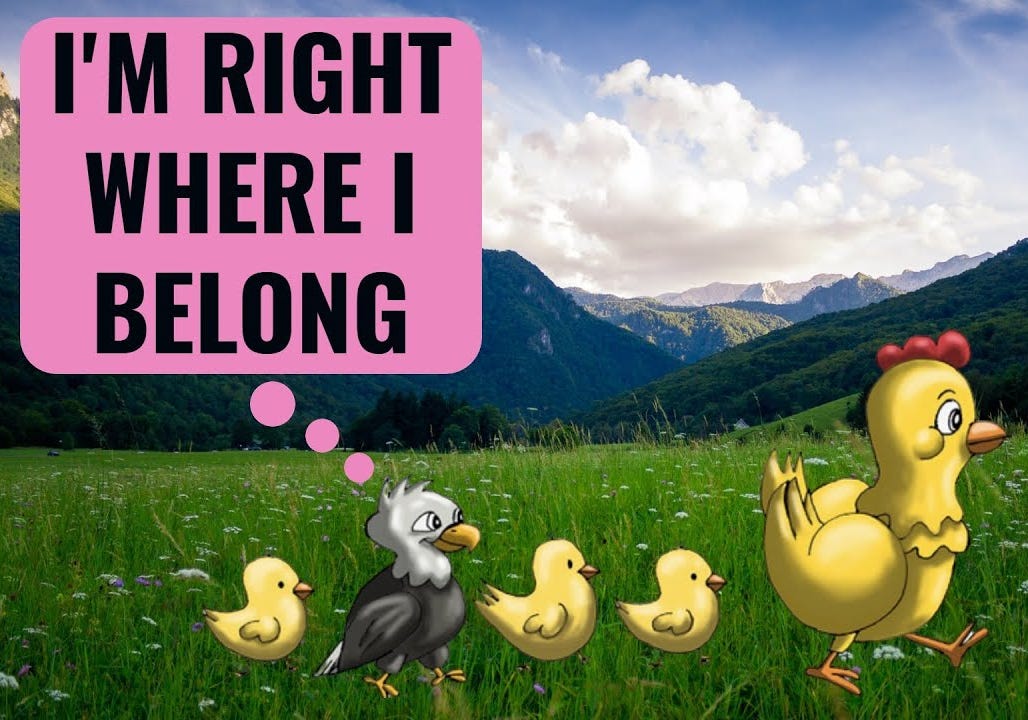
I first read the following parable in Indian-born psychotherapist and Jesuit priest Anthony DeMello’s book, The Song of the Bird:
A man found an eagle’s egg and put it in a nest of a barnyard hen. The eaglet hatched with the brood of chicks and grew up with them. All his life the eagle did what the barnyard chicks did, thinking he was a barnyard chicken. He scratched the earth for worms and insects. He clucked and cackled. And he would thrash his wings and fly a few feet into the air.
Years passed and the eagle grew very old. One day he saw a magnificent bird above him in the cloudless sky. It glided in graceful majesty among the powerful wind currents, with scarcely a beat on his strong golden wings. The old eagle looked up in awe. “Who’s that?” he asked. “That’s the eagle, the king of the birds,” said his neighbor. “He belongs to the sky. We belong to the earth – we’re chickens.” So the eagle lived and died a chicken, for that’s what he thought he was.
This story has great resonance for me. For most of my early life, I never thought much about myself or capabilities. The child of a broken home, many of my early years were spent alone in front of a TV with a bag of chips and soda. This lachkeyism was occasionally interrupted to care for my alcoholic mother and her enormous emotional needs. No one in my family or community paid special attention to me and my needs—no special schools, no support for my athletic pursuits, no praise. I was bounced carelessly from town to town and school to school (six total) before graduating high school —never long enough to make and retain friendships. I interpreted this neglect to mean I wasn’t deserving of anything special. I was just another barnyard chicken destined for a bucket of KFC or wherever.
In 2002, I met someone who dramatically changed my view of myself. Petra and I met in a smoky lower Manhattan nightclub of all places. Quickly bonding with one another, we eventually started hanging out, meeting up most weekends, taking long walks, visiting museums, and dining all around Manhattan and occasionally Connecticut, where she lived. Twenty years my senior, Petra and my friendship was not romantic in nature. Petra’s interest in me was me, not what she could get from me. She praised me, gave me books to read, and taught me things for my benefit. It was and continues to be my abundant experience that people seldom celebrate your greatness or help you tap your potential*, because to do so might elevate you above them or shine a spotlight on their inadequacies. The solidity of her ego allowed Petra to pay attention to me, not just her reflection of herself in me.
Many things in my life started to gel after the peak years of my friendship with Petra: I returned to Columbia University to complete my undergraduate degree and built a peer network of some of the world’s finest, most dynamic minds. Basically, Petra made me believe I was not a barnyard chicken, but a soaring eagle. And lo and behold, when I flapped my wings, I soared like she said I would.
I bring up the parable to illustrate how the peril of being defined by one’s environment, even when those definitions have little or no relation to reality. I bring up Petra to illustrate the critical importance of continually questioning these definitions.
*Unless many others are already doing these things.
Song of the day: