
Natural Intelligence
ChatGPT ain't got shit on God.

In case you’re not familiar with the concept, the technological singularity is the idea that Artificial Intelligence (AI) will one day become so advanced, it’ll start teaching and developing itself. This technological autogenesis will continue indefinitely, uninterrupted by the human bio breaks like eating, sleeping, and dying that previously thwarted innovation. The Matrix shows the potential downsides of this event, though, as I alluded to the other day regarding the transhumanist quest for immortality, some humanoids are excited for the potential merging of man and machine the singularity promises/portends. They are ready to exchange their fickle mortal flesh for their forever home on a server. These technooptimists are not fringe quacks, but people like Elon Musk, Sam Altman, Marc Andreesen, and others who can be found at the world’s highest socioeconomic strata.
Out-of-Shape, Billionaire Technology Investor Can’t Get Enough Technology, Money

Last week, famed venture capitalist Marc Andreeson published “The Techno-Optimist Manifesto.” In it, Andreesen boldly claims “there is no material problem —whether created by nature or by technology —that cannot be solved with more technology.” (More tech than what, who knows? Just
In 2018, I was commissioned by the innovation arm of a well-known hardware store to write a white paper about the future of housing. One area I explored was innovative building materials. I was ruminating on the qualities of an ideal building material—one technology might make possible. It would be strong, easy to manufacture, maintain, and dispose of, it would have excellent thermal performance and be aesthetic. It would be…wood (or possibly stone, clay, and other organic, traditional building materials).
Technology still hasn’t synthesized a material that delivers as many positive properties as wood, as assessed across a material’s lifecycle. But technology has made materials that are easier to manufacture and cheaper than wood, even if they’re impossible to dispose of. So companies like BASF keep developing ever more complicated, toxic, and low-cost synthetic building materials to solve a problem that doesn’t need to exist.
Robotic construction was another exploration area, so I thought about the qualities of a perfect robot. It’d be self-learning, bio-based, it would be flexibly fueled, easy to manufacture, maintain, and dispose of, and upgradeable. This perfect robot would be…a human. I wondered why there’s so much hype about robots —ones that require lithium-ion batteries that die in four hours —when a human will work overtime fueled by a bag of Cool Ranch Doritos.
Like wood, technology has not, nor ever will produce a robot to match the brilliance of the innate technology and design logic found in any human. But robots provide predictable operations (no sick leave, family drama, health insurance, etc.) and you can work a robot to death with a manageable moral hangover. So robots are our future, apparently. Yay.
I have a theory that The Book of Genesis is a story based on a real, albeit distant memory of a time when humans lived in harmony with nature. A time when water and food abounded, when the weather was always mild, when we lived simply, dancing, singing, and playing together. Nature provided everything we needed. But then one day, we thought, “it might be cool to have more than what we need. Let’s go one louder.” Nature wasn’t enough. Our flesh wasn’t enough. God wasn’t enough. We wanted more. We wanted bottomless mimosas, Botox, and OLED screens. We disregarded the perfection of the garden, eventually throwing a subdivision in its place, hoping it’ll keep us satisfied until our Bahamian cruise in September.
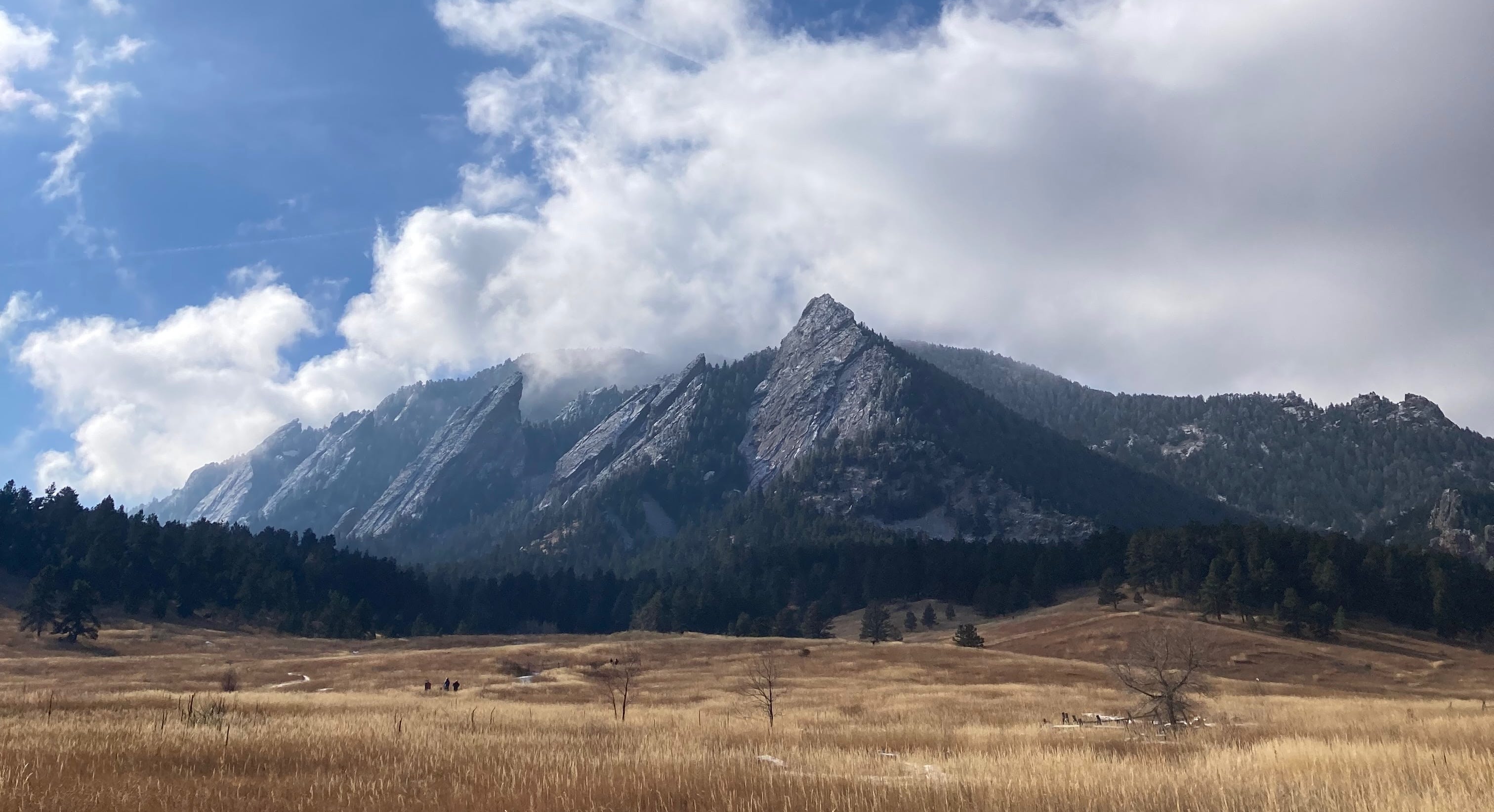
I frequently think about Edenic life when I’m on Boulder’s Green Mountain. I lived in NYC for many years and frequently marveled at the grandeur of human achievement manifested in the cityscape. The buildings, roads, transit systems, the movement of people—it’s all amazing. But when I contrast NYC’s manmade grandeur to Green Mountain’s natural grandeur, the former seems a lot less grand. Green Mountain stands almost 3,000 feet above downtown Boulder, which is roughly the height of the Empire State Building and Freedom Tower if they were stacked on top of one another. Green is billions of years old, its shapes and surfaces perfectly formed and changing in a dance with the elements. The massif will likely be around one billion years from now. Most of NYC’s skyline didn’t exist 150 years ago, when the buildings could first be built over five stories. That aggregates of NYC’s cityscape require constant upkeep and I strongly suspect much of it won’t be around, or at least useable, another 150 years from now.
The mountain is also where I can taste the perfection of God in me, stripped of screens, superfluous stuff, societal obligations, and performative action. It’s just me moving up and down a mountain, often with a friend or two, enjoying God’s handiwork around and within me. Experiencing this elemental beauty makes it seem pretty perverse to me that so many don’t honor the wisdom of nature inside and out, who are constantly craving more stuff, speed, food, and power than they need. It’s really quite enough.