
Normal Extremes
Life lessons from the trail running GOAT, Kílian Jornet.

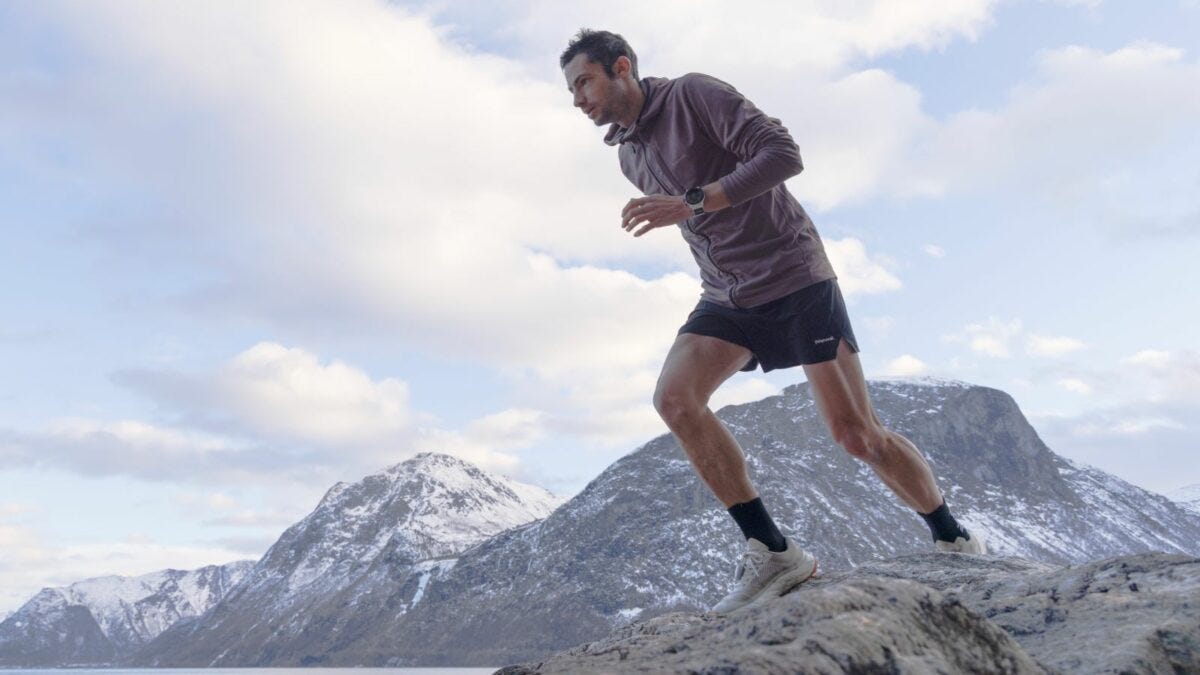
The other day, the New York Times published an interview with Spanish ultrarunning and mountaineering superstar Kílian Jornet. While many flatlanders may not know Kílian, he’s a legend in the mountain running world. He’s won the biggest ultramarathons like Western States Endurance Race and Hardrock 100. He’s climbed the world’s highest peaks, including Everest twice in a week without supplemental oxygen. Most recently, he completed his States of Elevation project, in which he ascended all 72 peaks over 14,000 feet in the lower 48 states. And he traveled to the peaks by bike, logging a total of 2,500 miles for the project’s 31 day duration.
The heading of the Times’ interview reads, “The Interview: Kílian Jornet on What We Can Learn From Pushing Our Bodies to Extremes.” And the interviewer, Lulu Garcia-Navarro, is understandably in awe of Kílian’s strength and endurance. After all, there are only a handful of people on the planet who could possibly hang with Kílian for a day of his journey, must less all 31. But the heading got me thinking about what it means to push our bodies to extremes.
I have never taken on physical challenges anywhere near that of Kílian’s, but I have done stuff many might consider extreme. For example, in the summer of 1997 when I was 21, I rode 5,500 miles from Boulder, Colorado to Seattle, Washington, and then to Portland, Maine. In one ten day period of that trip, I covered 1,000 miles. Around that time, I also biked both islands in New Zealand, the California coast, and through the mountains of Colorado. Last year, as I’ve probably noted one too many times, I ran 2,100 miles with over 500,000 feet of elevation gain. No, I’m not Kílian, but I’m no slouch either.
What was clear during all of my endeavors, and something that Kílian mentions in the interview, is how our bodies can adapt to whatever we throw at it. Kílian remarked of this:
The first week, I was feeling horrible. The altitude plus the dry air plus the physical effort that I was doing for more than 20 hours every day—I was on my edge. And then suddenly I really felt that my body stopped to fight those things and started to adapt. I don’t know how to describe it, but I really had this feeling of my body opening up and accepting what I was putting on it. At the end of the trip, I could have continued for another month. My body was feeling, That’s the new normal for this guy.
For a long time, there was an idea that most humans only use 10 percent of their brains. Apparently, the science on this figure may not be correct, but it’s anecdotally plausible to suggest most of us only use a fraction of our cognitive capabilities —a fraction that’s shrinking as people offload their cognition to AI. Similarly, it’s easy to believe that most of us only use a fraction of our physical potential. Consider these statistics that speak to the pitiable state of the average American’s physical fitness and health:
The obesity rate in the U.S. may be as high as 68.6 percent!
In 2023, 919,032 people died from cardiovascular disease (CDC).
15.8 percent of the U.S. population is diabetic with 95,190 deaths per annum (CDC).
The average American spends 18.6 minutes a day exercising (BLS), and anywhere from four to ten hours a day consuming media on TV, computer, and phone screens.
Living a sedentary life, consuming mostly ultra-processed foods, taking too many medications, staring at screens all day, living with chronic stress —this is pushing the body to extremes, but not in the way Kílian does. Instead of risking death from falling off a mountain, this extreme lifestyle puts the average American on a collision course with chronic disease, weakness, immobility, depression, anxiety, and premature death. Unfortunately, this extreme is normal for so many.

I’m confident most of us have more of Kílian’s physical capabilities than we think, and it might be time to reassess what’s normal and extreme. Maybe we need a new normal? (Pun intended.)
Along these lines, since the start of 2026, I’ve rejiggered my normal physical routine. I’ve logged over 40 miles per week and ascended Boulder’s Green Mountain 16 times for a total of 43,000 feet on the year. This is the most I’ve ever run in 20 days, and while fatigued, the physical capacity I’m building makes the fatigue easier to bear.
The question my experiment is trying to answer is, “what am I capable of?” Most of us limit our answers to this question to past experiences or environmental influences. And if our past experiences and influencers were limited in their capabilities, so too are our answers. On the other hand, people like Kílian, whose capabilities are not constrained by their past experiences and influencers, are wont to keep pushing the boundaries of their capabilities, physical and otherwise, showing what’s possible from this thing called life.
The NYT story was not in the Sports section, but News. Kilian has transcended both physical and media limits. And he's a gracious person with strong environmental ethics.
I'm even considering being inspired my him! I haven't run Green almost every day, but am considering being less curmudgeonly and becoming inspired.
In the meantime, nice 'David' photo!