
The Minimalism Documentary: A Decade Later
At least 5 of my 15 minutes of fame happened when I was interviewed for a low-budget documentary about minimalism. 10 years after its release, I have thoughts about the doc and its impact on society.

In 2014, Joshua Fields Milburn reached out to me to see if I’d be interested in participating in a documentary about minimalism, entitled Minimalism: A Documentary About the Important Things. I met Josh while working at a startup called LifeEdited, which was attempting to bring micro-apartments into mainstream real estate markets. A big part of my job was preaching “the luxury of less,” the tagline we used to describe the economic, ecological, and existential benefits of having and using less stuff. Josh, along with his buddy Ryan, made up “The Minimalists,” bloggers who were preaching the gospel of less. I had already interviewed them for LifeEdited’s newsletter. Their documentary seemed like a logical collaboration, and I enthusiastically agreed to participate. I also introduced them to LifeEdited’s CEO Graham, my ex-wife, and friend Colin Beavan (aka “No Impact Man”), all of whom appeared in the documentary as well.
The documentary centered on Josh and Ryan as they toured the country promoting their book, The Things That Remain. The tour footage is interspersed with Josh and Ryan’s origin story and interviews from various experts, including me, speaking about the harms of overconsuming and the joys of consuming less.
The production team, which included Josh, Ryan, and director Matt D’Avella, didn’t have ambitions beyond making the rounds at film festivals and some limited release showings. But those ambitions were greatly exceeded when the documentary was added to Netflix’s catalogue in 2016. It eventually left Netflix, but not before being viewed 85 million times. It was put on Youtube a few years ago, where it’s been viewed 15 million times to date.
I think the documentary became popular because it provided a coherent argument for why one can’t consume their way into happiness. This argument stands in sharp contrast to the mainstream, which is constantly urging people to consume more: cars, clothes, electronics, square feet, etc. Many people told me the documentary made them question why they consumed as much as they did. It opened their eyes to the hidden impacts consumption was having on their finances, environment, and wellbeing. It also brought a number of fringe trends, including minimalism, tiny home living, and vanlife into mainstream consciousness.
I’m happy with the small contribution I made to the documentary, looking at overconsumption as a systemic issue (i.e. a feature, not a bug) connected to the sprawling way most homes are sized and located. I link this sprawl to loneliness, obesity, and other negative health outcomes. My positions have stayed true since the documentary was filmed.
The Story
While I’m happy I was in the documentary and with what I said, my appearance may have shielded me from the documentary’s problems, of which there were many. One of which was The Minimalists origin story, which goes as follows:
Childhood friends Josh and Ryan were living the American dream as young adults, working six-figure jobs, renting big houses, driving fancy cars, buying tons of stuff, and racking up a massive amount of debt. Then one day Josh learned about people who live with minimal possessions. Minimalists. He stopped consuming and spending so much money. He became happy. Ryan saw his happy friend and followed suit. Free from unnecessary stuff, the pair had more money and felt freer. They eventually quit their jobs and became professional minimalists. This story has been repeated over and over and over again —in blog posts, books, speaking engagements, and the documentary. The story’s details and moral never budge: consume less, become happier. It’s that simple. (I did not see the 2021 Netflix documentary, Less is Now, but heard it covered much the same grounds.)
I don’t want to come off as a jaded minimalist, but after hearing Josh’s story for the hundredth time, I realized they didn’t share more because they didn’t have more. The Minimalists’ paucity of stuff was matched by their paucity of experience. Sure, getting rid of unnecessary stuff (material or immaterial) may be necessary for existential liberation, but it’s definitely not sufficient.
Most spiritual traditions —from Jainism to Buddhism to Christianity and others —have ancient ascetic practices. But the documentary makes no mention of these traditions or practices. In fact, the whole narrative is largely disconnected from the people, principles, and philosophies that shaped the human experience across the ages. The reason for this, I believe, is that The Minimalists want minimalism to be its own religion —one unburdened by God and esoteric concepts like the nature of reality and the afterlife. In Minimalism the religion, salvation is on the other side of removing unnecessary possessions from one’s life.
From what I know, Josh was raised by a Jesus-loving, alcoholic, hoarder mother. In conversations, Josh expressed to me his antipathy towards Christianity and concerns that he’d end up like his mom. While Josh may have resisted Christianity in name, he ended up emulating it in form. His minimalism origin story was, in fact, his Testimony : the story of how he was lost and saved by Jes…um…Minimalism. If this sounds hyperbolic, consider a recent newsletter entitled, “What Would Joshua Own?” You can take the boy out of church….
The Experts
Then there’s the matter of the documentary’s experts, the most famous of which is Sam Harris, an indefatigable Democratic Party booster and Israeli apologist, and one of the “Four Horsemen” of the New Atheism movement. From all I can gather, the Hollywood nepo-baby Harris was not and is not a minimalist, residing in a 7,000 square foot home when the documentary was made. He’s also outright hostile towards the world’s billions of believers, saying such things as:
The problem with religion, because it’s been sheltered from criticism [funny, I didn’t realize religions were shielded from criticism], is that it allows people to believe en masse what only idiots or lunatics could believe in isolation.
Harris’ vitriol for religion is funny, because many people are drawn to minimalism through their faith, including Joshua Becker, the Trump-loving, Christian Evangelist also featured in the documentary.

There’s nothing wrong with showcasing different people with different beliefs arriving at a similar conclusion. But this conclusion is not a durable philosophy, and it’s certainly not a religion. It’s a grab-bag of opinions shared by people of questionable authority, like Harris and my multimillionaire former employer Graham, who owned three homes when the documentary was made. These experts were chosen, not because they possessed great truths and lived experience as minimalists (though several of us did have the experience). They were chosen to affirm the movie’s conclusion: i.e. that having too much stuff is a bad thing. As they say in improv comedy, “yes, and….”
More than Minimal
The documentary was a success insofar as it told people what not to do, and to some extent, why. Don’t consume more than what you need because it’ll make you broke and stressed out and destroy the environment. Got it.
What it was less successful at was explaining what’s on the other side of decluttering. Removing distractions may provide temporary freedom and clarity, but figuring out what to do with that freedom and clarity is not obvious, and often spurs a whole new set of existential dilemmas. I’ve been in a ton of harrowing situations in my life —overcoming addiction, marriage, children, divorce, losing parents, injury, etc. —that my minimalist habits did nothing to shield me from. For that relief, I needed wisdom. I needed a path, guides, and community. I needed God. I did not need cheap axioms dished out by wannabe prophets.
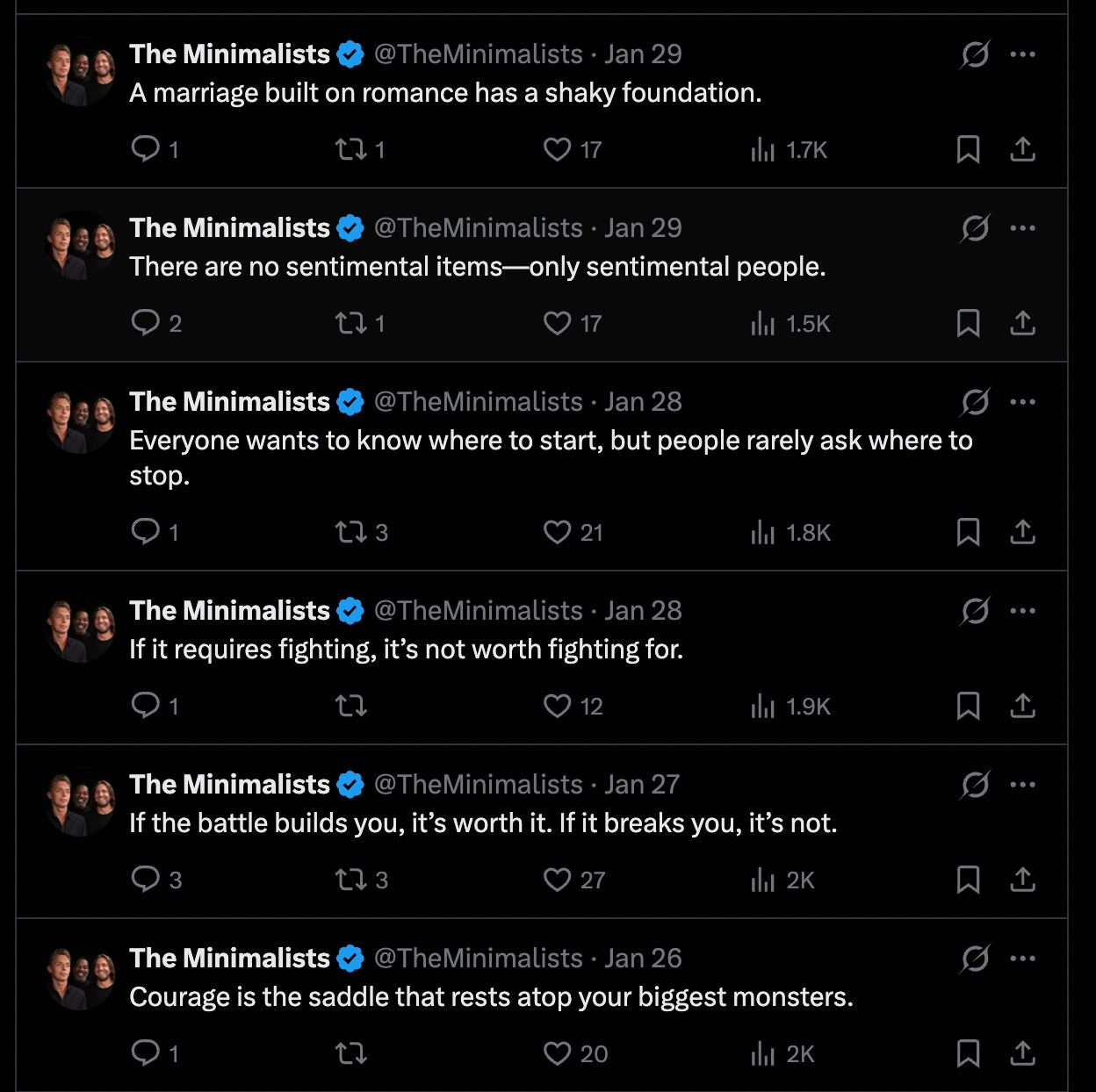
One of the problems with the documentary it that it presents consumer goods—both their absence and presence —as the malady rather than a symptom. This is understandable. It’s a movie about minimalism. But the malady has nothing to do with the stuff. The malady is that consuming has become a replacement for the soul’s desire for divine union. Based on the presentation of their material, I don’t think Josh and Ryan know much about that search or union.
But if I had to sum up my biggest issue with the documentary, it’s that it’s fake. Minimalism is fake religion, and The Minimalists are its fake high priests. The documentary makes it seem like spiritual growth is easy. It’s not.
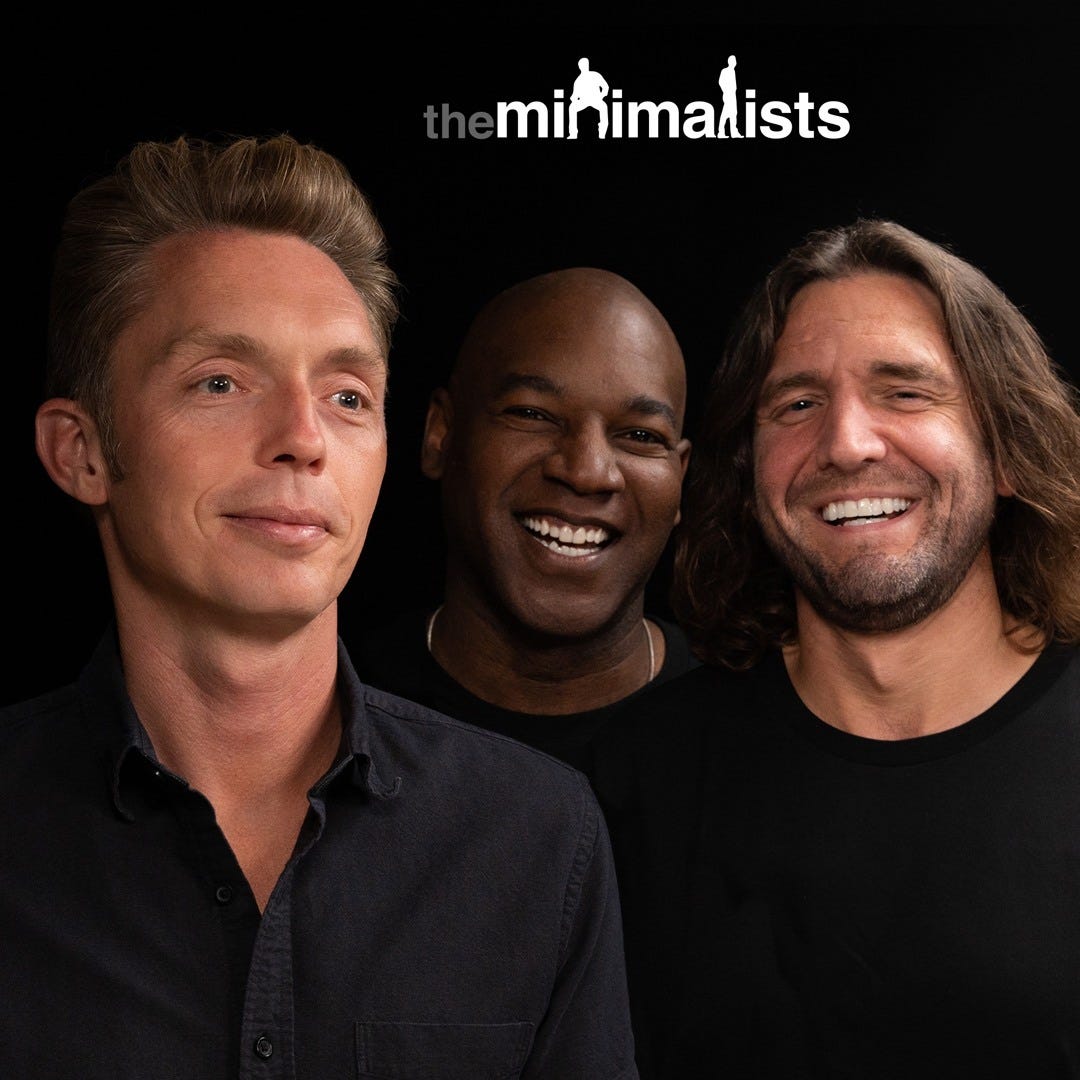
I want to emphasize that, despite my criticisms, I don’t regret participating in the documentary. If the documentary’s only legacy was keeping a few tons of crap out of landfills and making a few million people question their consumer habits, then it was a success. I just don’t think it went far enough, largely, as I explained, because The Minimalists didn’t have anything more than what they gave. They mistakenly think their origin story is a hero’s journey that brought them to a higher state of consciousness. That’s a story I can’t buy. In my abundant experience, spiritual growth is arrived at in the crucible of suffering and repeatedly stress tested over a lifetime. That’s a message that likely wouldn’t play well on Netflix, and perhaps why I’m writing in relative obscurity while The Minimalists have millions of followers.
Addendum
There are a few random things that bother me about Josh and The Minimalists that I think bear mentioning, but had no place in the above piece:
In recent years, Josh frequently refers to his daughter. I’m pretty sure he married into his paternity. I think adoption is a great thing, but the cucky, performative way he writes about the girl is gross.
Josh has a course called “How to Write Better.” Write better than what or who? Than a fire ant? Than a cup of coffee? Josh is not a good writer, but doesn’t seem to know it. He reminds me of the saying, “Trump is a poor man’s idea of a rich man.” Josh is an illiterate man’s idea of a good writer. Anyone taking his course should have their writing evaluated by a qualified editor and their head evaluated by a qualified therapist or clergy member.
The addition of T.K. Coleman around 2019 sure seemed like a response to the popularity of BLM rather than an authentic addition to The Minimalists’ threadbare message.
Two of the things that apparently got tossed in one of The Minimalists’ purging sessions was wit and humor. While The Minimalists make jokes, most of them are the kind of stuff people force themselves to chuckle at to indicate agreement with the joke’s conceit. Joshua Fields Millburn takes minimalism and himself very seriously, as evidenced by his use of three names and his fake serious stares. Ironically, this studied-seriousness makes it hard for me to take him seriously.
Josh is The Minimalists. He’s the one with the axioms. He’s the one standing in the foreground of most of their promo pictures. While a nice guy, Ryan always seemed to be going along for the ride. Josh really needs an ego check, which is part of the intention of this piece.
I very much appreciate what I'm taking as your main theme: Making do with less stuff is a good plan but is half the equation; a fuller inner experience can be added, providing context and meaning for the external, and on it's own.
The whole essay was positive and helpful context and insights. The Addendum struck a different tone, being a bit sour.
Thank you for your insights and efforts!
“I dabbled in pacifism once, not in Nam of course”. I agree with your premise that this all seems a bit contrived. Consumption for basic need vs excessive need seems to be the point, do I need that other house? The only thing I consume in excess is an insane, perhaps unhealthy, amount of laps on my local hill.